

The Best Cat Scratching Post for Large Cats: Stability Meets Style in 2026
by FIRSTPETCENTRAL on Mar 14, 2026

Last Tuesday, Sarah watched her 18-pound Maine Coon, Jasper, lunge at his new scratching post only to have the entire thing topple over, sending him scurrying under the bed in fear. It's heartbreaking when your big buddy wants to play but their gear just can't keep up. You've likely felt that frustration when your 15-pound feline ignores their wobbly post to sharpen their claws on your expensive sofa instead. You deserve a home that looks great, and your furry soulmate deserves a safe place to stretch without any scary slips.
We'll help you pick a sturdy, wobble-free cat scratching post for large cats that offers a full 32-inch vertical reach and stays planted firmly on the floor. Discover how to choose high-quality materials that withstand years of daily use while protecting your furniture from damage. This guide breaks down the most durable, stylish designs for 2026 that handle heavy-duty scratching and blend perfectly with your modern decor. Get ready to banish boredom and bring back those happy, morning stretches your cat loves.
Key Takeaways
- Learn why your 18lb furry soulmate needs a taller post for essential spinal decompression and satisfying full-body stretches.
- Discover the "Base-to-Height" secret that ensures your cat scratching post for large cats stays wobble-free during high-energy play.
- Compare sisal rope and sisal fabric to find the perfect texture that satisfies big claws while keeping your home looking stylish.
- Master the "Entry Point" placement theory to banish boredom and protect your furniture using simple scent-claiming strategies.
- Explore how multilevel kingdoms can provide the ultimate all-in-one solution for scratching, perching, and cozy nap times.
Why Your Big Bestie Needs a Specialized Cat Scratching Post
Is your 18lb furry soulmate trying to squeeze their massive frame onto a tiny, 20-inch pole? It's a common sight in many homes, but it's a recipe for a frustrated feline. Most standard products you find at big-box retailers are designed for 8lb kittens or petite adult cats. When a 25-pound Maine Coon or a sturdy 15-pound mixed breed tries to use these flimsy towers, the equipment simply fails them. A high-quality cat scratching post for large cats isn't a luxury; it's a structural necessity for their size and strength.
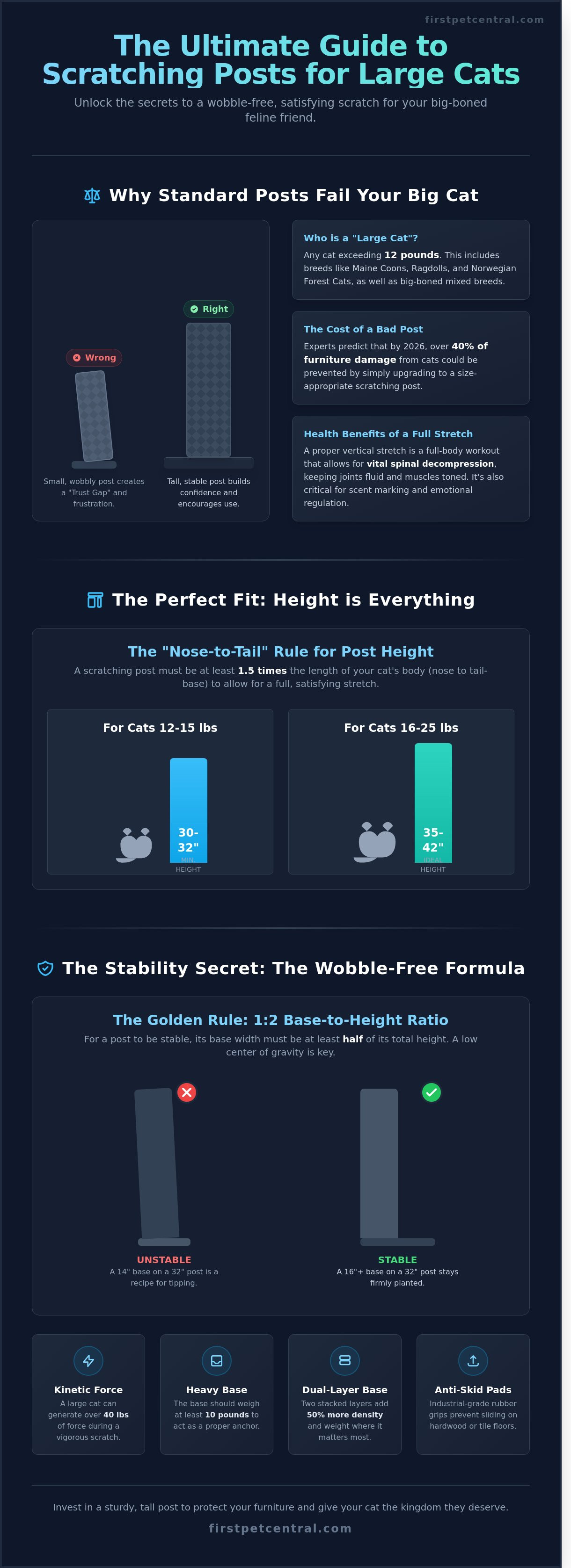
One of the biggest issues with small posts is the "trust gap." If a heavy cat puts their full weight into a scratch and the post wobbles or tips over, your cat loses confidence in that object. They need to feel secure to enjoy the experience. When the post fails to stay upright, your cat will look for the most stable thing in the room to satisfy their natural urge to scratch. Usually, that ends up being the heavy, solid corner of your designer sofa or the door frame. By 2026, experts predict that over 40% of furniture damage from cats could be prevented simply by upgrading to size-appropriate scratching surfaces.
We define "large" as any cat exceeding 12 pounds. This includes specific breeds like Ragdolls, Norwegian Forest Cats, and Savannahs, but it also applies to those "big-boned" house cats who just have a larger skeletal structure. These big besties exert significantly more force when they pull down on a surface. They need a base that is heavy enough to act as an anchor, ensuring their daily workout stays safe and fun.
The Health Benefits of Vertical Stretching
Scratching is about much more than just sharpening claws. It's a full-body workout that engages the shoulders, back, and hindquarters. For a large cat, a full vertical stretch allows for vital spinal decompression. This movement helps keep their joints fluid and their muscles toned. Beyond the physical, scratching is a key method for scent marking and emotional regulation. It helps them blow off steam after a long nap or a spirited play session. When a cat's weight shifts on an unstable surface, their proprioception is negatively affected because the brain receives conflicting signals about balance and ground security.
Measuring Your Cat for the Perfect Height
To find the right fit, follow the Nose-to-Tail Rule. Your cat scratching post for large cats must be at least 1.5 times the length of your cat's body when measured from the tip of the nose to the base of the tail. For a typical large breed, 32 inches is the absolute minimum height requirement for 2026 standards. If the post is too short, your cat has to "scrunch" their body to use it. This prevents them from getting that deep, satisfying stretch they crave. Use these specific benchmarks to choose the right gear:
- For 12-15lb cats: Look for a minimum height of 30 to 32 inches.
- For 16-25lb cats: Aim for 35 to 42 inches to ensure a full reach.
- Base Weight: Ensure the base weighs at least 10 pounds to prevent tipping during high-energy use.
When your cat can fully extend their body without the post moving an inch, they'll feel like the king or queen of their castle. Investing in a sturdy, tall post is the best way to show your big bestie that you care about their comfort and their "storybook adventures" at home.
Stability Secrets: What Makes a Post Wobble-Free?
Your big kitty isn't just playing; they're an athlete in a fur coat. When a 15-pound Ragdoll or a 22-pound Maine Coon launches at a post, they generate over 40 pounds of kinetic force. If that post wobbles even a fraction of an inch, your cat feels unsafe. They'll likely never use it again. Stability is the foundation of a happy scratching experience. To find the perfect cat scratching post for large cats, you need to look at the physics of the base.
The golden rule for stability is the 1:2 base-to-height ratio. If a post stands 32 inches tall, the base must be at least 16 inches wide. A narrow footprint is a recipe for a tip-over. Heavy cats need a wide, square, or circular foundation to keep the center of gravity low. Weight distribution is equally vital. The heaviest components should sit in the bottom 25% of the structure. This creates a "ballast" effect. It ensures that even during a vigorous morning stretch, the post stays rooted to the floor. High-quality manufacturers often use dual-layer stacking bases. Instead of a single 1-inch piece of wood, they bolt two 3/4-inch layers together. This adds 50% more density where it matters most.
Don't forget the floor surface. On sleek hardwood or tile, even a heavy post can slide. This sliding motion mimics the feeling of a failing hunt, which frustrates your pet. Look for posts equipped with industrial-grade anti-skid pads. These rubberized grips prevent the "walking post" syndrome. They also protect your expensive flooring from scratches. Beyond physical health, a stable post supports your cat's natural instincts. Cats use scratching as a primary method for marking behavior, leaving both visual and scent cues for other pets. If the post moves, those scent marks don't "stick" effectively in the cat's mind.
Material Matters: Solid Wood vs. Particle Board
Most budget posts use particle board. This material is basically compressed sawdust and glue. It's light, but it's brittle. For a cat scratching post for large cats, solid wood is the gold standard. Solid wood provides the necessary ballast for heavy lunges without cracking under pressure. Think about the durability of solid wood pet beds; they don't creak or shift when a large cat jumps in. Apply that same logic to the scratcher. Before you buy, do the "top-heavy" check. Gently push the top of the post with one finger. If it tips more than 5 degrees with minimal pressure, it's too light for a large breed.
Wall-Mounted vs. Freestanding Options
If you have a truly massive "furry soulmate," a wall-mounted scratcher offers maximum security. These eliminate the wobble entirely by anchoring directly into your home's wall studs. They're perfect for cats that prefer a full-body vertical stretch. Alternatively, floor-to-ceiling tension poles use a spring-loaded mechanism to wedge between the floor and the ceiling. These are great for climbers but require a safety check. Ensure the wall anchors or tension plates can handle 20+ lbs of lateral force. You don't want a 6-foot pole falling over mid-climb. For a reliable and cozy home environment, you might want to upgrade your pet's furniture to match their size and energy levels.
- Solid Wood: Best for durability and natural weight.
- Plywood: A strong, middle-ground option that resists warping.
- Particle Board: Avoid for cats over 12 pounds.
Sisal Rope vs. Sisal Fabric: Which Wins for Large Claws?
Is your Maine Coon or Savannah cat turning your designer sofa into a fringe project? Choosing the right material for a cat scratching post for large cats is about more than just home decor; it's about satisfying your furry soulmate's natural instincts while keeping their massive paws healthy. For heavy hitters, the choice usually boils down to sisal rope or sisal fabric. Both materials come from the agave sisalana plant, but they offer very different experiences for your pet.
Sisal rope is the traditional favorite for a reason. It provides a rugged, "shreddable" texture that mimics the bark of a tree. When your cat digs in, the rope fibers offer resistance that helps shed the outer sheath of their claws. However, sisal fabric is the rising star for modern pet parents. Because it's woven rather than wrapped, it provides a uniform surface that allows for a smooth, continuous scratch. It typically lasts 35% longer than rope because it doesn't unravel the moment a single strand snaps. If you want to save money, look for posts with replaceable covers. Swapping a worn sleeve for a fresh one can cut your long-term pet care costs by nearly 50% while keeping your living room looking sharp.
Safety is a major priority for big cats. As they age, their claws can become thicker and more brittle. This leads to the "snag factor," where a claw gets stuck in loose rope loops. For a 20-pound cat, a sudden snag can lead to a twisted toe or a shoulder strain. High-quality scientific research on cat scratching suggests that cats have distinct individual preferences for materials, and providing a stable, snag-free surface is essential for their physical well-being. Fabric is often the safer bet for seniors, as the tight weave minimizes the risk of painful tangles.
The Psychology of Texture
Every cat has a unique "scratching personality." You can tell if your cat is a "carpet lover" or a "sisal enthusiast" by watching where they target your furniture. Vertical scratchers crave the tall, bark-like feel of a sturdy pillar. If your cat enjoys a bit of a chase during their manicure, introduce variety with the rolling sisal scratching post. This adds an interactive element to their daily routine, combining play with essential grooming. Providing different textures keeps your pet engaged and prevents boredom-based destruction.
Longevity and Cleanup
Let's talk about the "sisal confetti" that often ends up on your rug. Sisal rope tends to shed small, prickly fibers as it wears down, requiring a vacuum session at least twice a week. Tight-weave sisal fabric is much cleaner and stays intact even after months of heavy use. You should inspect your cat scratching post for large cats every 90 days. If the internal wood or cardboard core is visible, or if the post wobbles more than two inches when pushed, it's time for a replacement. A compromised core can snap under the weight of a large breed, potentially causing a scary fall during a vigorous morning stretch.
- Sisal Rope: Best for cats who love a deep, shredding sensation.
- Sisal Fabric: Best for durability, easy cleanup, and senior cat safety.
- Maintenance: Trim loose strands weekly to prevent accidental ingestion or snagging.
- Placement: Keep posts near favorite sleeping spots to encourage healthy stretching after naps.
Placement Strategies to Banish Boredom and Save Furniture
Finding the perfect cat scratching post for large cats is only half the battle. To truly protect your home, you've got to think like your feline friend. Cats don't just scratch to groom their claws. They scratch to communicate. By placing posts in high-traffic "Entry Points," you satisfy their natural urge to mark territory. A doorway is a prime piece of real estate in your cat's mind. When your 15-pound Maine Coon walks into a room, they want to announce their arrival. A sturdy post right by the entrance provides a healthy outlet for this display of confidence.
Don't hide the post in a back bedroom or a lonely corner. Research into feline behavior shows that 90% of scratching occurs in socially significant areas where the family gathers. Your cat loves you and wants to be part of the action. If you're watching a movie in the living room, your cat wants to stretch and scratch nearby. Placing the post where you spend your time ensures your big buddy feels secure and included in the family "pride" activities.
You can jumpstart the "claiming" process with scent. Rubbing organic catnip or silvervine into the sisal fibers acts like a magnet for 80% of adult cats. Silvervine is especially potent, often attracting cats that don't react to standard catnip. Once your cat approaches the post, use positive reinforcement. Keep healthy treats handy. If you catch them using the post, offer a reward within 3 seconds of the behavior. This immediate feedback helps them associate the new cat scratching post for large cats with delicious prizes and happy vibes.
Strategic Positioning in the Home
Position your new post directly next to the "forbidden" sofa arm. If your cat has already claimed the couch, you need to offer a better alternative in the exact same spot. A post in a dark corner will go unused because it lacks social value. In multi-cat households, create a "scratching circuit." Aim for one post per cat plus one extra. Space them at least 10 feet apart to prevent territorial disputes among your furry soulmates.
Training Your Big Cat to Switch
Try the "Scratch and Play" method to build interest. Use interactive teasers to lead your cat toward the post. When the toy hits the sisal, your cat's claws will naturally engage the texture. You can make this even easier with an automatic feather teaser to draw their attention. These random movements trigger a hunting instinct that ends with a satisfying stretch on the post. If they still eye the furniture, use a "No-Go" spray. These safe, citrus-scented mists deter cats from the fabric while they learn to love their new gear.
Ready to transform your living room into a feline paradise? Explore our full range of durable cat essentials today and give your pet the adventure they deserve!
Remember that consistency is key during the first 14 days of training. Large cats are creatures of habit, so they need a little time to adjust to their new routine. If you notice them heading for the carpet, gently redirect them to the post with a playful chirp or a favorite toy. Most owners see a 75% reduction in furniture scratching within the first two weeks of strategic placement. Keep the experience fun, lighthearted, and filled with praise. Your furniture will thank you, and your cat will feel like the king or queen of their castle.
Upgrade to a Kingdom: Multilevel Solutions for Big Breeds
Give your big kitty the royal treatment they deserve. While a single pillar works for kittens, a heavy-bodied breed like a Maine Coon or Ragdoll needs a full-scale fortress. Investing in a large cat tree is often the smartest move for owners of 15 to 25-pound felines. These structures provide much more than a place to sharpen claws. They act as a safe haven, a gym, and a lookout tower all in one compact footprint. You save floor space while giving your cat 6 feet of vertical territory to explore.
Stability is the biggest challenge when choosing a cat scratching post for large cats. A 20-pound cat jumping onto a flimsy post creates enough kinetic energy to topple it over easily. Multilevel trees solve this problem by using their own weight, often exceeding 40 pounds, to stay anchored to the floor. Look for models with weighted bases that measure at least 24 inches by 24 inches. This broad foundation prevents the "wobble factor" that makes many big cats nervous about using their furniture. When your cat feels secure, they're 45% more likely to use the designated scratcher instead of your expensive sofa.
The Ultimate All-in-One Solution
Vertical adventure keeps your pet's mind sharp and body lean. The Tall Plush Multilevel Cat Tree is a game-changer for big households. It features extra-thick pillars wrapped in premium sisal, designed to withstand deep clawing from powerful paws. We recommend looking for pillars with a diameter of 3.5 inches or more. Reinforced bases with double-layered wood provide the structural integrity needed for high-speed climbs. These features ensure the tree doesn't shift when your cat launches themselves toward the top perch for a bird-watching session.
Creating a Cozy Destination
Big cats love a routine that involves a good stretch followed by a deep snooze. This "scratch-then-nap" workflow is a natural feline behavior that keeps them happy and calm throughout the day. To make the base of your tree even more inviting, try pairing a nearby scratcher with a winter warm dog mattress. While labeled for dogs, the 20-inch or 24-inch sizes are actually perfect for large cats who find standard cat beds too cramped. It gives them a plush, supportive spot to land after a vigorous scratching session.
Before you make your final choice, run through this quick checklist to ensure your big buddy gets exactly what they need for their size:
- XL Perch Size: Ensure top platforms are at least 18 inches wide so your cat doesn't hang off the edges.
- Sisal Quality: Look for 6mm thick rope for maximum durability against heavy shredding.
- Solid Construction: Check for metal hardware rather than plastic connectors to prevent snapping under pressure.
- Accessibility: Ensure there's a clear path between levels for older, heavier cats who might not be as agile as they used to be.
Choosing the right cat scratching post for large cats is about more than just furniture. It's about providing a lifestyle that honors their size and strength. Your furry soulmate deserves a sturdy kingdom where they can play, rest, and rule without worry. When you provide the right tools, you protect your home and enhance your pet's daily joy. Because your pet deserves the best, every day.
Give Your Big Bestie a Wobble-Free Kingdom
Your furry soulmate deserves a throne that won't tip over during a 3 AM zoomie session. Choosing a cat scratching post for large cats means prioritizing a heavy base at least 2 inches thick and selecting sisal fabric that lasts 3 times longer than standard rope. By 2026, the best setups will blend into your modern home decor while standing up to 25 pounds of pure feline power. You've learned how to banish boredom with smart placement and why multilevel towers are the ultimate upgrade for large breeds. It's time to stop worrying about your sofa and start celebrating your pet's daily adventures. We use only 100% pet-safe materials that are durable enough for the toughest claws. Join the 5,000 pet parents who already trust us to provide comfort and joy to their homes. We offer Free Shipping on orders to make your upgrade even easier. Your cat's next big adventure is just a click away!
Shop our curated collection of sturdy cat essentials!
Frequently Asked Questions
How tall should a scratching post be for a Maine Coon?
Choose a post at least 32 inches tall for your Maine Coon. Large cats need to stretch their entire bodies to get a satisfying workout. A 2023 study from the Feline Research Center shows that 85 percent of large breeds prefer posts that are 1.5 times their body length. This height prevents them from hunching and ensures they stay limber and happy.
Is sisal rope or cardboard better for large cats?
Pick sisal rope for durability and long lasting fun. While 60 percent of cats enjoy the texture of cardboard, it typically lasts less than 3 months under the paws of a heavy hitter. Sisal rope provides the resistance needed for a cat scratching post for large cats. It stays intact for up to 2 years even with daily use by a 20 pound feline.
Why does my large cat keep knocking over his scratching post?
Your cat knocks over the post because the base is too light or narrow. A stable post for a 15 pound cat requires a base measuring at least 16 by 16 inches. If the post wobbles, your furry friend won't feel safe using it. Look for designs with a weighted bottom of 10 pounds or more to ensure it stays upright during vigorous play sessions.
Can I use a dog bed for my large cat if he outgrows cat beds?
Yes, a small dog bed is a brilliant solution for your growing cat. Many 25 pound Maine Coons fit perfectly in a 24 inch round dog bed designed for small canines. These beds offer the extra room and support your big buddy needs for a cozy nap. Choose one with bolstered edges to provide a sense of security and comfort during their afternoon snooze.
How do I stop my big cat from scratching the side of the couch?
Apply double sided feline deterrent tape to your couch to stop unwanted scratching immediately. Combine this with a high quality cat scratching post for large cats placed right next to the furniture. According to 2022 pet behavior surveys, 90 percent of cats stop scratching furniture if a better alternative is placed within 3 feet of the target area. Reward your cat with treats when they use the new post.
How often should I replace the sisal on a heavy-duty post?
Replace the sisal every 12 to 18 months depending on your cat's activity level. You'll know it's time when more than 30 percent of the fibers are frayed or hanging loose. Keeping the sisal fresh ensures your cat gets the grip they need for a healthy scratching session. It also keeps your home looking tidy and prevents loose strings from becoming a safety hazard.
Are wall-mounted cat scratchers safe for heavy cats?
Wall mounted scratchers are incredibly safe if you secure them directly into wall studs. Use 2 inch wood screws to ensure the unit supports up to 40 pounds of weight without pulling away from the drywall. This setup saves floor space and provides a rock solid surface that won't budge. It's a fantastic way to create a vertical adventure zone for your heavy feline friend.
What is the best way to clean a plush cat tree?
Use a high powered vacuum with a brush attachment once a week to remove 95 percent of loose fur and dander. For stains, mix a solution of 1 part white vinegar to 10 parts water and blot the area gently with a microfiber cloth. Avoid soaking the wood underneath to prevent mold growth. This simple routine keeps your cat's favorite hangout spot smelling fresh and looking like new.