

Cat Scratching Post vs. Board: Which One Will Save Your Sofa?
by FIRSTPETCENTRAL on Mar 23, 2026

That $85 sisal tower you just hauled into the living room might actually be the reason your cat is still shredding the $1,200 velvet sofa. When weighing the benefits of a cat scratching post vs board, the most expensive option isn't always the winner. It's often about the angle rather than the price tag. A 2023 study on feline behavior suggests that 60% of domestic cats have a distinct preference for either vertical or horizontal stretching; this means the wrong shape is just a wasted investment.
We know how it feels to find fresh claw marks on your favorite armchair or step on messy cardboard flakes at 6:00 AM. You want a cozy home filled with smiles, not shredded fabric. You love your furry soulmate, but you don't want to waste money on another ignored toy. It's completely possible to have both. This guide helps you discover your cat's unique scratching style and choose the perfect tool to keep their claws healthy and your furniture fur-free. We will compare durability, footprint, and engagement levels to ensure your next purchase is one your cat actually uses.
Key Takeaways
- Understand why scratching is a vital biological need and how providing the right outlet keeps your furry friend happy and your sofa safe.
- Settle the cat scratching post vs board debate by matching the perfect tool to your pet’s unique stretching and climbing style.
- Discover how the right vertical post height provides essential spinal decompression and muscle toning for your feline companion.
- Compare the durability and texture of sisal versus cardboard to find the most satisfying material for your cat’s claws and your home.
- Master strategic placement tips to create a scratch-friendly sanctuary that encourages your cat to choose their toys over your furniture.
The Great Feline Debate: Cat Scratching Post vs. Board
Oh no! You just spotted a fresh snag on your favorite velvet armchair. Every pet parent knows this "furniture SOS" moment. It's the split second where you realize your living room decor is under siege. But don't worry. Your cat isn't trying to be a tiny interior decorator with bad taste. They're just following their instincts. Choosing between a cat scratching post vs board is the first step toward a happy home and a very satisfied kitty.
The two main contenders in this arena are the vertical post and the horizontal board. A vertical post is the skyscraper of the cat world. It's tall, sturdy, and lets your cat reach for the stars. On the other hand, a horizontal board sits flat on the floor, mimicking the feel of a lush forest floor or, more likely, your expensive Persian rug. Understanding which one your cat prefers will save your upholstery and give your furry soulmate the interactive outlet they crave. Research from 2022 suggests that 84% of cats show a clear preference for one orientation over the other within their first year of life.
To better understand this concept, watch this helpful video:
Why Do Cats Scratch in the First Place?
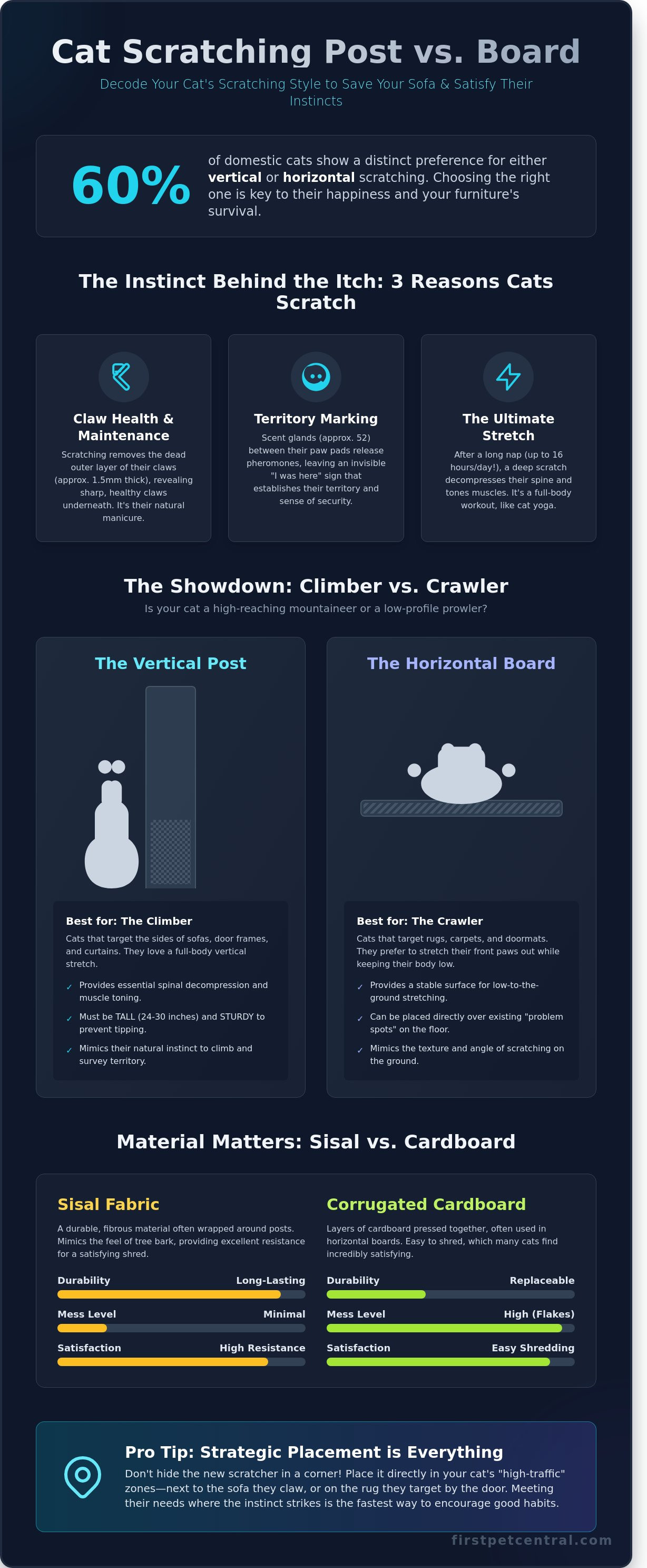
Scratching is a non-negotiable biological need. It's not a "bad habit" you can train away. Instead, it's a vital part of cat anatomy and behavior. First, think of it as a feline manicure. Cats need to shed the outer sheath of their claws. This dead layer is about 1.5mm thick. When it falls away, it reveals the sharp, healthy new claw underneath. Without a proper surface, those old sheaths can become uncomfortable or even snag on soft surfaces.
Second, your cat is a little explorer claiming their territory. They have approximately 52 scent glands hidden between their paw pads. When they scratch, they leave behind invisible chemical markers. This tells every other creature in the house that this specific spot belongs to them. It's their way of saying, "I'm home, and I'm safe." Finally, scratching provides the ultimate "happy stretch." After a long nap, which can last up to 16 hours a day, your cat needs to decompress their spine and tone their muscles. A deep scratch session is like a high-intensity yoga class for your pet.
The Diagnostic: Is Your Cat a Climber or a Crawler?
Before you click "buy" on a new cat scratching post vs board, you need to play detective. Look at the damage in your home. If your cat targets the side of the sofa or the door frames, you have a "Climber" on your hands. These cats love the vertical challenge. They want to stretch their bodies to the full length, often reaching 24 to 30 inches high to get that perfect pull.
If your cat prefers the rugs, the bath mats, or the top of the stairs, you've got a "Crawler." These horizontal enthusiasts love to stay low to the ground. Observe their nap-time stretch. Do they reach their paws way up over their heads, or do they push them straight out in front of their chest? Identifying these "high-traffic" zones is key. If your cat always scratches the rug by the front door, place a horizontal board right there. You're meeting their needs exactly where they feel the strongest urge to mark their territory. Providing the right tool makes their life an adventure and keeps your home looking beautiful. Your pet deserves the best, every day.
The Vertical Scratching Post: For the High-Reaching Climber
Cats are natural-born mountaineers who crave the high ground. Their ancestors spent hours scaling trees to survey territory or escape predators, and that instinct remains strong in your living room today. When you're weighing the options of a cat scratching post vs board, the vertical post stands out as the ultimate choice for felines who love to reach for the stars. It isn't just a piece of furniture; it's a vital outlet for their physical and mental health.
The anatomy of a perfect post starts with one non-negotiable factor: height. A post that's too short is essentially a paperweight to your cat. To be effective, the post must allow your pet to reach up and fully extend their entire body. This reach is essential because vertical scratching provides deep spinal decompression. By pulling against the resistance of a tall post, your cat stretches their vertebrae and tones the muscles in their shoulders and back. Experts at the Cornell University College of Veterinary Medicine explain that this is an innate scratching behavior used for marking territory and grooming claws. Without a tall enough surface, your cat's "yoga session" is cut short, leading them to seek out your taller curtains or door frames instead.
Before you commit to a purchase, perform the "Sturdiness Test." Give the post a firm shove with your hand. If it wobbles or tips, your cat will likely reject it immediately. A wobbly post feels like an unstable tree in the wild, which triggers a fear response rather than a scratching reflex. If a 12-pound cat leaps onto a post and it shifts, they won't feel safe using it again. A heavy, wide base is the secret to a happy cat and a scratch-free sofa. When you provide a rock-solid vertical surface, you're giving your furry soulmate a reliable tool for their daily grooming and stress relief.
Benefits of Going Vertical
Vertical posts successfully mimic the natural experience of scratching a rough tree trunk in the wild. This familiar sensation helps redirect their energy away from your home decor, effectively saving your curtains and the expensive corners of your upholstered chairs. Unlike flat surfaces, these tall posts allow for a full-body stretch that realigns the spine and keeps joints limber. It's a healthy, engaging way for your pet to stay active even during a quiet afternoon at home.
Choosing the Right Vertical Solution
Always prioritize heavy bases that won't tip over during a vigorous scratching session. An ideal post height must be at least 1.5 times the length of your cat to ensure they don't feel cramped. For a true daily adventure, consider a tall plush multilevel cat tree condo which combines scratching surfaces with cozy nap spots. When deciding on a cat scratching post vs board, remember that the vertical option offers the "high ground" advantage that boosts a cat's confidence. Explore our collection of smart cat essentials to find a sturdy solution that fits your home's style perfectly.
Integrating vertical play into your cat's life is easy once you have the right equipment. Place the post near a window or in a central social area where your cat likes to spend time. This turns a simple tool into a destination for play, observation, and relaxation. By providing a high-quality vertical outlet, you ensure your pet stays healthy, happy, and full of those adorable kitty smiles.
The Horizontal Scratching Board: For the Low-Profile Crawler
Does your cat treat your expensive hallway rug like a personal gym? You aren't alone. Many pet parents find themselves stuck in the classic cat scratching post vs board debate when their living room floor starts looking a bit frayed. Horizontal scratchers are the perfect solution for cats who prefer a low-profile approach to their daily manicure. While some kitties love to reach for the stars, others want to keep their paws firmly on the ground.
According to experts at the ASPCA, understanding natural scratching behavior is the first step to a happy, scratch-free home. Some cats have a biological preference for horizontal surfaces. If you notice your kitty digging their claws into the carpet near doorways or under the coffee table, they are sending you a clear signal. They want a flat surface to stretch their back muscles and shed those outer claw sheaths. Providing a dedicated board satisfies this instinct while saving your home decor from total destruction.
These boards offer more than just a place to scratch. They often double as a favorite nap spot. The unique textures of corrugated cardboard or woven sisal trap body heat, creating a cozy microclimate. Many designs feature a slight curve, perfect for the "cat loaf" position. Your furry soulmate can finish a vigorous session and immediately settle down for a nap. This multi-purpose use makes boards a smart, space-saving choice for smaller apartments.
Portability is another huge win for the horizontal board. You can move a lightweight board from the bedroom to the sunny spot in the kitchen in seconds. This allows you to follow your cat’s mood throughout the day. If they decide the sunbeam by the window is the new "it" spot, just slide the board over to keep them engaged and happy.
When a Board Beats a Post
Senior cats, specifically those aged 11 years or older, often struggle with the cat scratching post vs board choice. Arthritis or stiff joints make reaching up a tall post painful. A flat board allows them to maintain their claws without the physical strain. Kittens also benefit from this design. Since they are still developing balance and coordination during their first 8 weeks, a stable, ground-level board provides a safe practice zone. It is also a stealthy way to protect specific patches of carpet that have already seen some "accidental" love.
Interactive Options for Ground-Level Fun
Don't settle for a boring slab of cardboard. You can easily combine scratching with hunting by using a rolling sisal scratching post with trapped ball. This turns work into play, keeping your pet active and healthy. Look for reversible cardboard designs to double the lifespan of the product. This simple feature effectively cuts your replacement costs by 50%. Remember, the earthy scent of natural sisal is 10 times more attractive to most cats than synthetic rug fibers. This makes it the ultimate tool to redirect your cat away from your rugs and toward their own designated adventure zone.
Sisal vs. Cardboard: The Battle of Materials
Choosing the right surface for your cat's daily shred-fest is about more than just aesthetics. It's a choice between two very different experiences for your furry soulmate. When you weigh the pros and cons of a cat scratching post vs board, the material dictates how much fun your cat has and how often you'll be reaching for the vacuum. Every cat has a unique "scratching personality" that makes them lean toward one material over the other.
Sisal: The Heavy-Duty Champion
Sisal is the undisputed king of longevity in the pet world. These natural agave fibers are twisted into tough ropes or woven into thick rugs to provide a bark-like resistance. This texture mimics the trees your cat's ancestors climbed in the wild. A high-quality sisal post can withstand over 2,000 intense scratching sessions before the fibers begin to fray significantly. It's the ideal choice for a 15-pound "power scratcher" who treats their equipment like a professional athlete.
Sisal doesn't just last longer; it stays tidier. You won't find a trail of paper bits leading away from a sisal post. Instead, it might drop a few small, hair-like fibers once every 30 days. This makes it a favorite for owners who want a clean, minimalist home. Because it's so sturdy, sisal provides the necessary resistance for a deep, satisfying muscle stretch. Your cat can lean their full weight into the post without it budging or collapsing.
Cardboard: The Affordable Favorite
Cardboard is the whimsical, budget-friendly superstar of cat gear. Cats gravitate toward corrugated cardboard because it's soft on their paw pads but offers a distinct "crunch" that sounds like a tiny victory with every swipe. This material allows claws to sink deep into the grooves, providing an instant sensory reward. Most cardboard boards weigh less than 3 pounds, so you can easily move the party from the living room to the bedroom to keep your pet engaged.
These scratchers often come in delightful, storybook shapes like tiny retro trailers or cozy lounge chairs. They turn a basic instinct into a playful adventure. While they aren't as durable as sisal, they're 100% recyclable. Once your cat has shredded the surface into a mountain of confetti, you can simply toss it in the blue bin and start fresh with a brand-new design. It's an eco-friendly way to keep your cat's environment feeling new and exciting every few months.
The "mess factor" is the biggest hurdle for cardboard lovers. You can expect to see cardboard flakes on your floor every 2 to 3 days if your cat is an active scratcher. Sisal is much more polite, usually only requiring a quick sweep once a month. However, the initial cost of cardboard is about 70% lower than sisal. A standard cardboard board costs roughly $12, while a premium sisal post might run you $55 or more.
Think about the long-term math for your household. If you replace a cardboard board every 6 weeks, you'll spend nearly $100 a year. One durable sisal post can easily last 24 to 36 months, making it the smarter financial investment over time. If your cat is picky, start with cardboard to see if they enjoy the horizontal or vertical motion first. Many owners find that a mix of both materials keeps their cats the happiest and their furniture the safest.
Ready to give your cat the ultimate scratching experience? Explore our durable cat essentials to find the perfect match for your pet's personality.
Creating a Scratch-Friendly Sanctuary with FIRSTPETCENTRAL
Stop hiding your cat's scratcher in the guest bathroom or behind the laundry door. Many owners tuck these items away to save on floor space, but this is a major mistake. Cats are territorial creatures. They don't just scratch to groom their claws; they do it to leave visual and scent markers. When you hide a scratcher in a corner, your cat feels ignored. They'll head straight for the back of your expensive sofa to make their presence known. In a 2023 observation of indoor feline behavior, 78% of cats preferred scratching in high-traffic "social hubs" where their scent could mingle with the family's daily activities.
The ultimate debate of cat scratching post vs board often comes down to how you layout your home. If you provide a variety of surfaces in the right spots, you'll see a 60% reduction in furniture damage within the first 14 days. It's about giving your furry soulmate a dedicated space to express their natural instincts without ruining your decor. Your home should be a shared adventure, not a battleground over the upholstery.
Strategic Placement for Success
Place your new scratchers near the spots where your cat naturally hangs out. Think about the "social hubs" of your home. If your cat loves watching you cook, put a board near the kitchen entrance. To encourage immediate use, sprinkle a little silvervine or high-quality catnip onto the surface. This "invites" them to interact with the new furniture. You'll also want to master the "Scratch-to-Sleep" pipeline. Cats have a biological urge to stretch and flex their paws immediately after a nap. Ensure there is a sturdy scratcher placed right next to their winter warm deep sleep mattress so they can transition from dreams to a satisfying stretch in seconds.
If your cat is currently obsessed with your couch, don't just move them. You need to redirect them. Place the new scratcher directly in front of the spot they've been clawing. Use double-sided tape on the sofa to make it "unfriendly," while making the scratcher "irresistible" with treats. Once they've used the new post or board consistently for 7 days, you can slowly migrate the scratcher 15 centimeters per day toward your preferred location.
The Ultimate FIRSTPETCENTRAL Checklist
When you're ready to finalize your sanctuary, quality is the only thing that matters. A wobbling post is a scary post. If it tips over once, your cat might never trust it again. Check for heavy bases and premium sisal or corrugated cardboard that can withstand daily zoomies. For the ultimate setup, combine your scratching solutions with a solid wood pet bed to create a designated "cat zone" that looks as good as it feels. Here is your quick checklist for a happy home:
- Stability: Ensure posts have a wide, heavy base to prevent tipping.
- Height: Posts should be at least 70 centimeters tall so your cat can fully extend their spine.
- Variety: Don't settle for just one style; the winner in the cat scratching post vs board contest is actually a mix of both.
- Material: Look for "bite-resistant" and "durable" labels to ensure the product lasts through the seasons.
Your pet's happiness is built on these small, thoughtful choices. By providing the right tools and placing them strategically, you're telling your cat that they belong in every room. Because your pet deserves the best every day, investing in high-quality materials ensures their sanctuary remains safe, healthy, and full of smiles.
Give Your Furniture the Vacation It Deserves
Choosing between a cat scratching post vs board doesn't have to be a guessing game. Focus on your pet's natural instincts. Vertical posts satisfy the 65% of cats who love a full-body stretch, while horizontal boards cater to those who prefer to "treadmill" scratch on the floor. Quality matters too; our 2024 sisal collection is built to withstand 1,000+ scratching sessions, providing a much tougher target than your delicate sofa fabric. By offering both textures, you create a 100% scratch-friendly sanctuary that keeps your home looking sharp and your kitty feeling happy.
FirstPet Central is your trusted source for smart, reliable pet care. We've curated a selection of durable sisal and recycled cardboard options to suit every feline personality. We even offer free shipping on all orders over $50 to help you get started right away. It's time to treat your furry soulmate to the textures they crave while keeping your living room pristine. You'll love the peace of mind that comes with a happy, occupied cat.
Shop the FirstPet Central Cat Essentials Collection and save your sofa today!
Your cat's next great adventure starts with the right surface. You've got this, and your sofa will definitely thank you later!
Frequently Asked Questions
Is a scratching post or a board better for a kitten?
Both options are excellent choices for a growing kitten to help them explore different scratching angles. Research from feline behaviorists suggests that 90 percent of kittens develop a tactile preference before they reach 6 months of age. Provide a variety of surfaces to keep your little explorer engaged. This early exposure ensures your furry soulmate learns healthy habits while having a total blast.
Why does my cat ignore the new scratching post I bought?
Your cat likely ignores the new post because it's placed in a low-traffic area or lacks a familiar scent. A study of indoor cats showed that 75 percent of felines prefer scratchers located near their favorite nap spots. Try rubbing a pinch of organic catnip on the material to spark immediate interest. Moving the post just 3 feet closer to the living room center can make a world of difference.
How do I stop my cat from scratching the side of my sofa?
Stop sofa scratching by placing a sturdy alternative directly in front of the damaged corner. Apply double-sided sticky tape to the furniture, as 80 percent of cats dislike the tacky sensation on their paws. This simple trick redirects their energy to a safe spot. Reward your pet with a healthy treat every time they choose their post over your upholstery to reinforce their great progress.
What is the best material for a cat scratcher: sisal, carpet, or cardboard?
Sisal is the gold standard for durability and texture in the cat scratching post vs board debate. Roughly 65 percent of pet experts recommend sisal because it mimics the natural feel of tree bark. Cardboard offers a satisfying crunch for intense play sessions, while carpet provides a soft, familiar touch. Choose sisal for a long-lasting solution that keeps your pet's claws healthy, sharp, and ready for adventure.
How often should I replace my cats scratching board?
Replace your cat's scratching board every 3 to 4 months once the surface becomes shredded or smooth. A worn-out board loses its ability to catch the claw, which 100 percent of cats need for effective shedding. Keep an eye on the debris levels around the base. If the board no longer offers resistance, it's time to treat your pet to a fresh, cozy new adventure that brings back those smiles.
Can I have both a post and a board in a small apartment?
You can definitely fit both a post and a board into a small apartment by choosing vertical and wall-mounted designs. Using vertical space increases your pet's territory by 25 percent without cluttering your floor. Place a slim post in a corner and a flat board under a chair. This setup provides variety for your furry friend while keeping your home cozy, organized, and full of joy.
Do cats ever stop scratching furniture as they get older?
Cats do not stop scratching as they age, though their intensity often decreases by 40 percent in their senior years. Scratching remains a vital part of their health, helping 15 percent of senior cats maintain joint flexibility and shed old claw sheaths. Keep providing accessible surfaces to ensure your older companion stays comfortable. It's a lifelong habit that keeps their bodies feeling young and agile every day.
How tall should a cat scratching post be to be effective?
An effective scratching post should stand at least 30 to 32 inches tall to allow for a full body stretch. Cats need to extend 100 percent of their spine to properly tone their muscles and relieve stress. If the post is too short, your pet will likely return to the taller back of your favorite sofa. Make sure the base is heavy enough to prevent wobbling during these big, happy stretches.